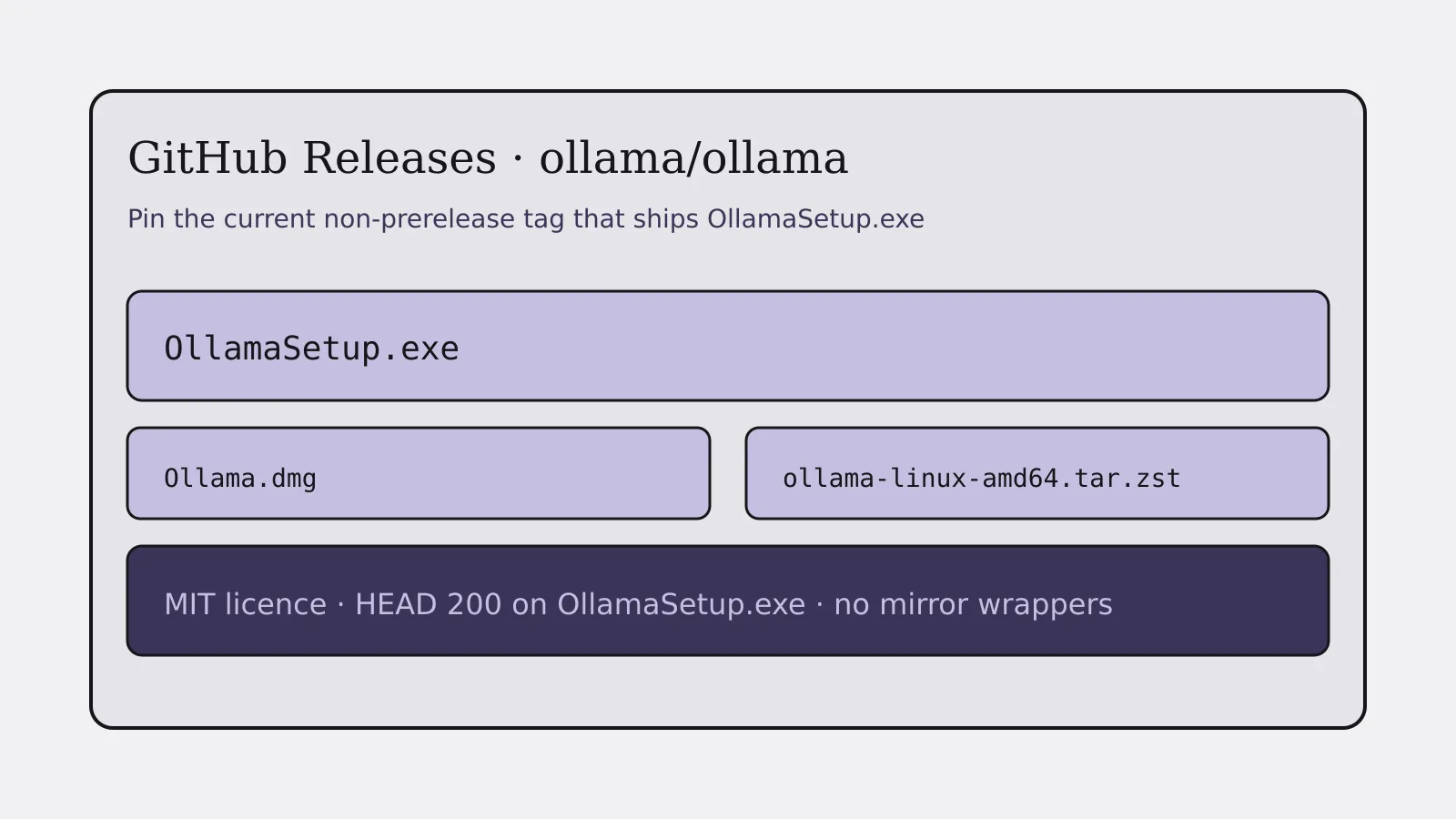
- Ollama-darwin.zip 189 MB 344k downloads
- ollama-windows-amd64.zip 1397 MB 11k downloads
- ollama-windows-arm64.zip 198 MB 214 downloads
- ollama-darwin.tgz 151 MB 1.8k downloads
- ollama-linux-amd64.tar.zst 1363 MB 56k downloads
- ollama-linux-arm64.tar.zst 1479 MB 5k downloads
- OllamaSetup.exe 1498 MB 367k downloads
- Ollama.dmg 189 MB 15k downloads
- install.sh 16 KB 59k downloads
ollama
Local model runner from the upstream MIT project
ollama is a free open-source local model runner people install when they want chat and serve on a machine they control. Take the Windows Setup executable from GitHub Releases, or use the verified winget and Homebrew doors on the same stable line.
- Run models locally without a cloud seat for day-one chats
- Official Windows Setup executable from GitHub Releases
- MIT source with a CLI on Windows, macOS, and Linux
By Herd Latch editorial team Current release, published September 14, 2026
Install Ollama 0.34.1
Windows
Paste into PowerShell or Windows Terminal:
winget install -e --id Ollama.OllamaPackage: microsoft/winget-pkgs (YAML-verified package id). Prefer the Windows Setup executable from GitHub Releases when you want the exact tag asset; winget is the first-party package-manager path..
Other Windows commands
GitHub Releases Windows Setup
Windows Setup executable from ReleasesOr download the file directly from the official GitHub release:
Download Windows Setup (.exe)Also on this release: Windows amd64 zip (portable)
Windows 10 or 11 (x64). Prefer the Windows Setup executable from the current non-prerelease tag that ships that asset, or the verified winget id when App Installer is present.
macOS
Paste into Terminal:
brew install --cask ollama-appPackage: Homebrew desktop cask on formulae.brew.sh (verified). Matching GitHub Releases disk image and darwin zip also ship on the same tag..
Other macOS commands
GitHub Releases macOS dmg
macOS disk image from Releases Homebrew formula (CLI bottle)
brew install ollamaOr download the file directly from the official GitHub release:
Download macOS .dmgAlso on this release: macOS darwin zip
macOS Sonoma or newer for the desktop cask, or the official disk image from the current non-prerelease tag. Open the official dmg when you skip brew.
Linux
Paste into your terminal:
curl -fsSL https://ollama.com/install.sh | shPackage: Official install.sh from the project site (also attached on GitHub Releases). Prefer the linux amd64 archive from the current non-prerelease tag when you want an offline extract..
Other Linux commands
GitHub Releases linux amd64 archive
linux amd64 archive from ReleasesOr download the file directly from the official GitHub release:
Download Linux amd64 tar.zstAlso on this release: Linux arm64 tar.zst, Official install.sh
A 64-bit Linux host with curl. Prefer the official install.sh pipe or the linux amd64 archive from the current non-prerelease tag.
Every file comes from ollama/ollama v0.34.1 on GitHub, the project's own release, unmodified.
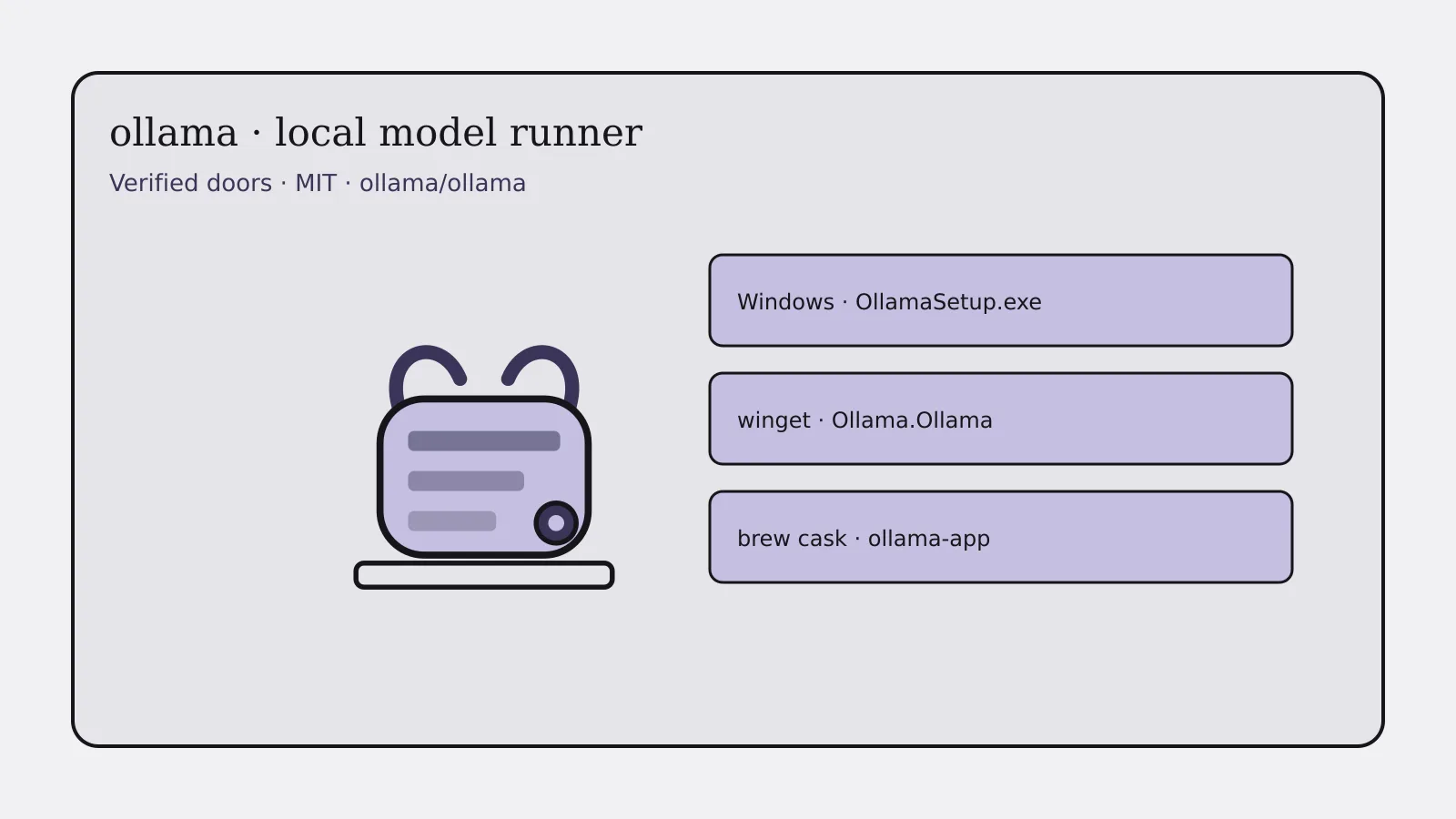
What this local model job needs
People who type ollama usually want a free local model runner they can install once and keep between experiments. The job is pulling a model, chatting with the CLI, and serving an API on a PC you control, not a browser demo and not a metered cloud seat.
The upstream open-source project behind that search ships a desktop tray app plus a CLI. Herd Latch maps the doors: the Windows Setup executable on GitHub Releases tags, the verified winget id, and the Homebrew desktop cask when those channels are allowed.
Related: releases, GitHub, download safely, Windows install.
LicenceMIT on GitHub LICENSE
Primary fileWindows Setup executable on release tags
Winget / brewVerified winget id · verified Homebrew cask
Why this desktop install path
A dedicated install stays on the machine after Setup. You control the update door. Model libraries, Modelfiles, and the local API live under your account instead of a temporary browser tab that forgets your lab layout.
Winget keeps fleet images honest when the catalog is allowed. The Setup executable keeps labs honest when package managers are blocked. Brew keeps Mac desks on the same project without hunting mirrors. The Linux install script and amd64 archive keep Linux desks on the same tag as Windows and macOS.
Proprietary GUI runners still win when a team already standardised on another brand with a polished model browser. Cloud chat seats do not replace an offline-capable local runner. Choose this MIT path when you want named Releases assets and CLI habits that start with a short prove command.
Install by operating system
Windows, macOS, and Linux all ship stranger-safe doors on the same stable tags. Prefer the package manager when it is allowed; fall back to the named Releases asset when catalogs are blocked.
| OS | Command or file | Package source | Guide |
|---|---|---|---|
| Windows | winget install -e --id Ollama.Ollama | microsoft/winget-pkgs · VERIFIED | Windows install |
| Windows (manual) | Windows Setup executable | GitHub Releases · primary stranger-safe | releases |
| macOS | brew install --cask ollama-app | Homebrew cask · VERIFIED | macOS install |
| Linux | curl -fsSL https://ollama.com/install.sh | sh | Official install script · Releases archive | Linux install |
Run the Windows winget line when App Installer is present:
winget install -e --id Ollama.OllamaOn macOS, prefer the verified desktop cask:
brew install --cask ollama-appOn Linux, the official install script is the common stranger-safe path:
curl -fsSL https://ollama.com/install.sh | shAfter install, prove the CLI with a small model:
ollama run llama3.2Longer Windows pages: install on Windows. Winget-only walkthrough: winget install. Installer walkthrough: Windows installer. Cluster pages: releases, GitHub, download safely, how to install winget.
How this client compares
People comparing this runner to other local tools pick by licence, platforms, and how much UI they want on day one. Numbers below are product facts, not rankings.
| Tool | Price posture | Open source | Platforms | Primary habit | Verdict for this job |
|---|---|---|---|---|---|
| This MIT runner | Free MIT runner | Yes (MIT) | Win / macOS / Linux | CLI chat + local API | Best when you want official Releases plus winget and brew doors |
| LM Studio | Freeware proprietary | No | Win / macOS / Linux | GUI model browser | Wins when a polished GUI browser matters more than MIT |
| GPT4All | Free | Yes (MIT family) | Win / macOS / Linux | Desktop chat UI | Wins when you already standardised on Nomic packs |
| Jan | Free | Yes (open) | Win / macOS / Linux | Desktop local AI | Wins for teams already on Jan workflows |
| llama.cpp | Free | Yes (MIT) | Multi | Engine / binaries | Wins for builders wiring custom inference, not a full app Setup |
LM Studio still wins for people who want a dense GUI catalog first. GPT4All wins when a team already ships those packs. llama.cpp wins when you are assembling a custom stack. This MIT runner wins when you want Releases assets and a short path to a CLI prove chat.
Head-to-head: vs LM Studio. Leaving a GUI rival: switch from LM Studio. More comparisons live under guides.
First-hour steps after install
These eight steps match a clean Windows desk. macOS and Linux follow the same prove-one-chat habit after their own installer doors.
- Open the official release door. Open GitHub Releases for the upstream repository on a current non-prerelease tag and confirm you see the Windows Setup executable, not a renamed portal setup.
- Prefer the Windows Setup from the current tag. Take the Windows Setup executable from the live non-prerelease tag that ships it. Keep one filename written on the machine ticket. The asset is large; expect a long download.
- Or run the verified winget id. When App Installer is present, run the verified winget install command for this project. That id is YAML-verified in microsoft/winget-pkgs and maps to the Setup executable.
- Finish the Windows Setup wizard. Approve UAC when Windows prompts. Complete Setup so the tray app and CLI land on PATH.
- Confirm the tray or CLI responds. Launch the app and confirm the tray icon appears, or run the version command in a new terminal before you pull models.
- Run one model to prove the install. Run a small model chat with the CLI and send one short prompt. That proves download, serve, and chat before you trust larger models.
- Note the local library path. Models land under the local library on disk. Confirm free space before large pulls, especially on lab images with small system volumes.
- Keep one update door. Return to the same GitHub Releases Setup file, winget upgrade, or brew cask upgrade. Skip adware wrappers that only rank for local AI searches.
First-run detail: first run. After install checklist: installed.
Skip prerelease tags when you want the current stable desk path. Prefer the newest non-prerelease tag that publishes the Windows Setup executable.
Safe download habits for ollama
Official doors are GitHub Releases for the upstream repository, the verified winget id, and the verified Homebrew cask. Those publish named assets. Advertising mirrors often rename the Setup and bundle extra offers.
Match the filename you expect before you run anything. The primary Windows stranger-safe file is the Setup executable on stable tags. A portable zip may also ship; take it only when your runbook documents a portable need.
Deep dive: download safely. Repo map: GitHub overview. Asset chooser: releases.
Models, Modelfiles, and everyday CLI
After install, the everyday habit is pulling a tag and starting a chat. List local models, then remove stale tags when disk pressure rises. Custom Modelfiles let you pin system prompts without leaving the MIT runner.
Examples you can run on your machine after install:
ollama run llama3.2API clients can talk to the local server after the service is up. Keep that loop on loopback until your network policy says otherwise. Guide: first run.
Lab and travel notes
Travel laptops benefit from a single documented installer door written beside the folder that holds the library. Lab images drift when someone installs a second mirror during a blocked SmartScreen prompt. Prefer returning to the same Releases URL, winget id, or brew cask instead of inventing a new download mid-flight.
School machines should receive the installer on hardware they control, plus a shared note for the update door. Shared desks should keep a short prove-one-chat checklist before calling the image ready.
Classroom images should pin the exact Setup filename beside the OS version. After every reimage, prove one short local chat before you call the machine ready.
That habit catches vanished install folders and adware shortcuts that reappear from old bookmark exports. Users who already live in a GUI rival can keep that path for browsing. Treat the Windows Setup as the dedicated path for teammates who need a named Releases asset with CLI control on day one.
Support rhythms for shared rooms
Helpdesks move faster when every ticket names the installer door and the Windows build together. Vague reports that only say chats feel wrong waste a day. Ask for the filename or winget id, the approximate install date, and whether a proxy changed during the complaint.
- Keep a spare USB with the current Setup executable for rooms without winget.
- Use a quiet prove-one-chat step before demoing a huge model pull.
- Inventory model allow-lists separately from the desktop binary.
A forgotten PATH refresh looks like a broken client. Tag hardware notes with the matching library path so substitutes do not guess under pressure. When imaging season arrives, freeze the golden machine only after a reboot test. Logon scripts and antivirus first-scan delays hide problems that a same-session demo misses. The boring reboot test saves weekend emergency calls.
Writing internal runbooks
Internal runbooks should quote the winget id, the brew cask, and the Releases URL without adding marketing adjectives. Staff skim under stress. A short checklist with five boxes outperforms a three-page essay that nobody finishes.
Include a rollback line: where the previous Setup lives, how to uninstall, and who owns the software library hash list. Rollback plans fail when the only copy sat on a retired laptop.
Translate jargon for volunteers. Say “use the official GitHub Setup file” instead of assuming everyone knows which mirror is safe. Clarity beats cleverness during the first week of a new semester.
How do I install the Windows build?
Prefer the Windows Setup from the current non-prerelease tag on the upstream GitHub Releases, or run the verified winget install command when App Installer is present. Both doors map to the same MIT build for a local model runner. Avoid renamed setups from advertising download portals that only rank for the head term.
Where should I download the installer?
Use GitHub Releases for the upstream repository, the verified winget package, or the verified Homebrew cask. Those doors publish named assets on stable tags. Softonic-style portals often wrap the same search intent with extra installers you did not ask for.
Is the desktop app free?
The runner is free under MIT. You can install and use it without buying a seat. Model weights you pull follow each model’s licence. Optional cloud services from other vendors are separate from this install path.
Can I switch from LM Studio into this client?
Yes. Install from GitHub Releases, winget, or brew, then pull models with the CLI. There is no automatic LM Studio library import. Prove one small model first. Guide: switch from LM Studio.
Does the desktop app work offline?
After you install the app and download each model you need, chats can run without the public internet. You need a network to pull new models or to fetch a newer Setup executable from Releases.
Profile and model habits that age well
Keep a short allow-list of model tags for shared rooms. Large experimental pulls fill disks and confuse the next class. Document which tags are blessed for demos. Remove stale tags during maintenance windows.
Custom Modelfiles belong in version control when a course depends on a fixed system prompt. Treat the Modelfile like any other lab config: review it when the base model tag changes.
API scripts should target loopback by default. Opening the server beyond the machine needs an explicit network decision, not a silent demo flag.
Imaging season without drama
Golden images should pin a non-prerelease tag that still ships the Windows Setup executable. Record the tag on the image build sheet. After sysprep or clone, open a terminal and prove a small CLI chat before you seal the image.
Winget-based images should confirm the package id resolves in the catalog used by that ring. Brew-based Mac images should pin the desktop cask. Linux images should document the install script versus an offline archive.
Writing clearer tickets
Tickets that say “AI broken” waste time. Ask for the OS, the door used (winget, Setup executable, brew, install script), the tag, and the exact CLI error. Attach version command output when possible.
If the failure is a pull timeout, note proxy settings. If the failure is disk full, note the library path free space. If the failure is PATH, ask whether the terminal was opened before Setup finished.
Classroom logistics for ollama labs
Scheduling ollama installs across a lab bank works better when one person stages the Windows Setup overnight and copies it to trusted media before students arrive. Partial downloads create support noise that looks like security failures but is usually truncated bits.
- Document which ring owns the blessed tag for ollama images.
- Volunteers need a five-box checklist: door, tag, prove chat, free space, update door.
- Travel carts should carry the Setup file and a SmartScreen filename note.
Shared accounts should avoid experimental multi-gigabyte tags on the golden profile. Scratch accounts exist for curiosity. Maintenance windows delete strays so the next ollama class starts with a known library.
API demos for ollama belong on loopback until a network owner signs off. Opening ports during a club meeting without review creates a different class of ticket than a missing PATH entry.
When two local AI apps share a disk, write which one is blessed for the course. Students click whichever shortcut is larger. Clarity beats clever branding on the desktop.
Print the Releases URL and the winget show command on the ollama lab sheet. Phones photograph well. Whiteboard URLs get erased overnight.
More install and setup guides
Browse the guide hub for OS installs, comparisons, and switch-from pages. Every guide links back to this pillar.
-
Install by operating system
Step-by-step installs with the exact command or file for each system.
-
Comparisons
ollama against other local model runners people ask about.
-
Switch and import
Move from another local AI app into ollama without rival-first titles.
-
Setup and models
First run, CLI ollama run examples, safety, and updates.
Official releases
All releases on GitHub- GitHub stars
- 181,164
- Downloads, last 1 releases
- 859k
- Latest version
- 0.34.1
Counts come from the GitHub API at build time and only cover the * tags shown here. Package managers (winget, Homebrew, Snap, Flathub) and app stores are not included.
Frequently asked questions
How do I install ollama on Windows?
Prefer the Windows Setup executable from the current non-prerelease tag on the upstream GitHub Releases, or run the verified winget id when App Installer is present. Both doors map to the same MIT desktop and CLI build for local models. Avoid renamed setups from advertising download portals.
Where should I download ollama?
Use GitHub Releases for the upstream repository, the verified winget package, or the Homebrew cask for the desktop app. Those doors publish named assets such as the Windows Setup executable and the macOS disk image on stable tags. Softonic-style portals often wrap the same search intent with extra installers you did not ask for.
Is ollama free and open source?
Yes. The runner is free under the MIT licence on GitHub. You can install, pull models, and run CLI chats without buying a seat. Model weights you download follow each model's own licence; the runner itself stays MIT.
Can I switch from LM Studio into ollama?
Yes. Install from GitHub Releases, winget, or brew, then pull the models you need with the CLI. There is no one-click LM Studio library importer. Guides cover phrase-first switch-from paths for LM Studio and GPT4All.
Does ollama work offline after install?
After the first download of the app and of each model you need, chat and serve can run without the public internet. You only need connectivity when you pull new models or check GitHub Releases for a newer Setup executable.